As facilitators, we constantly scan the room, process information, and decide on our next move. But what exactly are we looking at?
To navigate complex workshops and meetings, I use a framework called “The 4 Cameras of Metacognition.”
Imagine a TV production control room. The director and switcher monitor multiple camera feeds simultaneously, deciding which angle to broadcast to create the best show. Similarly, a facilitator must switch between different “cameras” (levels of awareness) to guide the group effectively.
Here is how to visualize and apply these 4 perspectives.
The 4 Cameras: What are you focusing on?
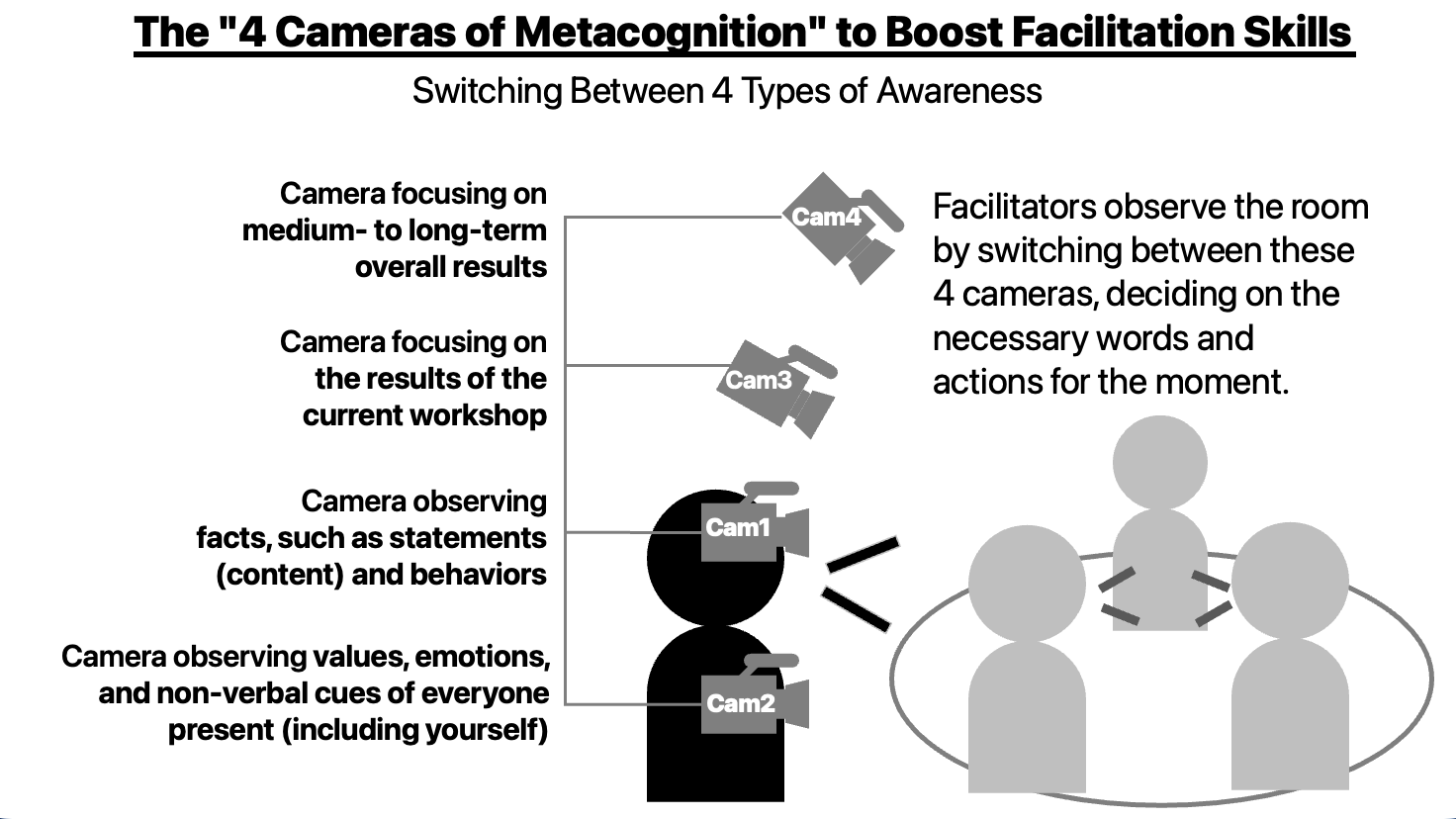
🎥 Camera 1: The Facts & Content This camera captures exactly what is being said and done. It focuses on the explicit content, the spoken words, and the observable facts in the room.
🎥 Camera 2: The Emotions & Values This camera looks deeper. It observes the internal state of the participants—and yourself. It picks up on values, non-verbal cues, relationships, and the emotional “vibe” of the room.
🎥 Camera 3: The Session Flow (The “Micro” View) This camera focuses on the narrative of the current workshop. It looks at the day’s flow and asks: “Given where we are right now, how do we structure the next hour to reach today’s goal?”.
🎥 Camera 4: The Big Picture (The “Macro” View) This camera takes a bird’s-eye view of the whole. It examines the situation through questions like: “What meaning does what is happening right now have from the overall perspective? What direction is this group trying to move toward? And what can be learned here?”
Visualizing it: The “Manga” Metaphor
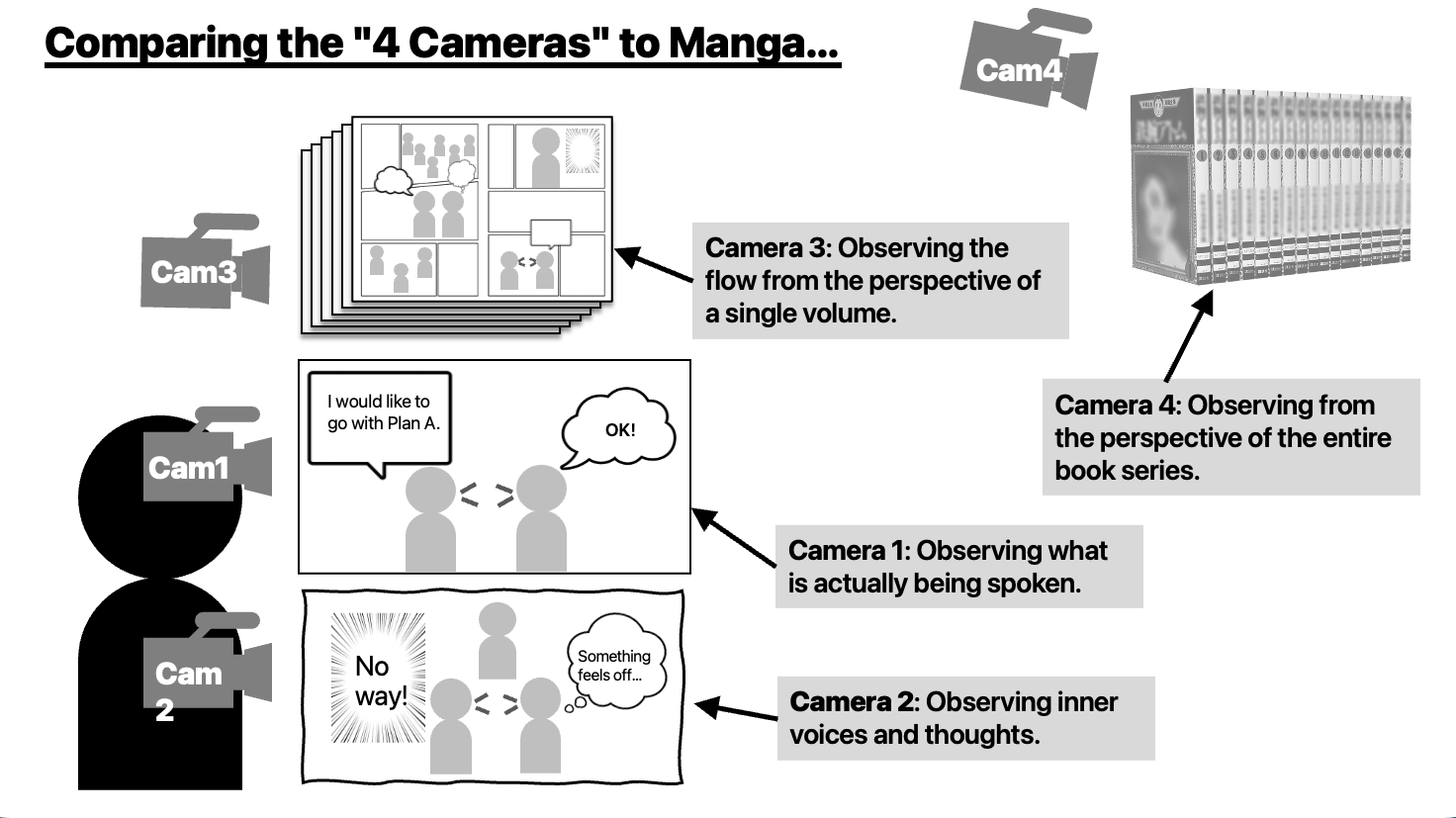
If you find the camera analogy abstract, think of it like reading a Manga (Comic):
• Camera 1 represents the solid speech bubbles. It is the actual dialogue text.
• Camera 2 represents the dashed “thought” bubbles. It is the inner voice, feelings, and unspoken context.
• Camera 3 is like reading one specific volume of the manga. It focuses on the story arc of that single book (the workshop).
• Camera 4 is like looking at the entire book series on a shelf. It understands how today’s “volume” fits into the complete saga (the long-term project).
How to Apply This
In my practice, I primarily try to keep my awareness tuned to Camera 2 (Emotions/Values) and Camera 3 (Session Flow) while facilitating.
However, I occasionally pause to check Camera 4: “What meaning does this situation have in the long run? What choice here will yield the best result for the project as a whole?” This allows me to steer the ship effectively.
⚠️ A Critical Reminder
There is one golden rule when using this framework:
Only Camera 1 represents objective facts.
Everything you perceive through Cameras 2, 3, and 4 is subjective. It is a hypothesis based on your experience and biases. Never assume your metacognition is 100% correct. Always treat your observations of feelings and future outcomes as “interpretations,” not absolute truths.